Thursday, November 29, 2007

Lifer! Brant (status pending?)


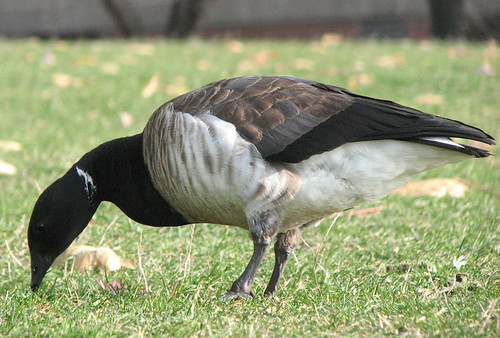
Photo courtesy of "Michael" on the Toronto and Southern Ontario Birding Forum.

On Saturday, a single Brant (pale-bellied) was reported from Harbour Square, Toronto, just west of Queens Quay where the ferries dock to cross to Center Island. The initial reporter mentioned that the bird was probably an escape as it was mingling with some resident Canada Geese in the small park next to the lake and was very easily approached. However, another person posted a reply on Sunday saying the bird actually had an injured leg (extreme swelling of the tarsus) and said that was the reason for the approachability. I decided to investigate (especially seeing as the bird is a lifer for me).

Here is where I attempt to rationalize why I am counting this species:

1) Time of year indicated that it could in fact be a wild-type bird as the report falls within fall migration dates.

2) The injury to the tarsus tells me that the bird stopped in a sheltered place in the small park among Canada geese in a metropolitan area where there is constant food availability and it is safer. Sadly, it could also mean it was injured by a pedestrian (I've seen Canada Geese along the Waterfront trail with injured wings). I believe it's due to the injury that the bird is so approachable (versus escapee). The leg is swollen enough that the bird will take a few steps then rest down on its belly and feed from a sitting position.

3) The bird didn't have any bands, nor did it have a deep belly, often demonstrated by domesticated waterfowl.

4) The bird was flying without any trouble, moving back and forth between the lake and the water (there is no beach here, so the geese have to fly over a railing to get to the lake).

5) I do not know Brant as a common domestic goose, nor do I often hear of escapes. However, when it comes down to it, someone could argue the exact opposite and probably convince me that the bird is uncountable. Perhaps a 6th point in my list could read "I need Brant for my lifelist." I guess I can rest easy on the fact that I'll no doubt get Brant in Ontario in the future.

Any thoughts?

Monday, November 26, 2007

High Park - Saturday

Just a quick update on my trip to High Park last Saturday. The weather was really great, cold but not bone-chilling and bird activity was decent. Immediately upon entering the park, I heard Robins and Chickadees singing as well as an abundance of Starlings (always present in large numbers). Just north of Colborne Lodge, I had Downy Woodpecker, Brown Creeper, Red-breasted Nuthatch, and White-breasted Nuthatch. There is an area just around the bend from the first parking lot in the park where someone puts out seed for the local birds and this keeps a number of the species just mentioned close-by (White-breasted Nuthatches always look like they're about to land on me and then turn in flight at the last second). In this spot, there were a lot of White-throated Sparrows feeding, a few Juncos, and a lot of House Sparrows. Overhead I heard a few flocks of Goldfinches. As I walked past this location, I saw an owl fly off in the distance (being harassed by songbirds). By its size, I would say Great Horned or Barred but I couldn't be sure. Still a nice sighting.

Later, I decided to check Grenadier Pond. There are still good numbers of Northern Shoveler, Hooded Merganser, Bufflehead, and Mallard. This time, I counted 5 Domestic Mallard types versus the three I've had consistently in the past. Only 1 pair of Mute Swan is present right now. Lastly, I had a single female Ruddy Duck on the pond. She actually swam right up to the shore into the shallows and preened for a while right in front of me. Sometimes I hate not having a camera.

Later on, on some trails, I had a flock of Common Redpoll fly over me while I was looking at a large group of Robins and Juncos (in another area where birds are often fed seed). In this location, I also had an interesting Junco that showed slight white wing-bars; not to the extent shown in Sibley's but not far off. I don't recall ever seeing this before.

Lastly, I have to report a Rufous Hummingbird right in Kingsville that has been hanging out at a feeder there for about a week now. Once again, a significantly rare bird is within short driving distance of my Leamington home and I can't go to see it! Although I was successful with my last chases, Northern Wheatear and White-faced Ibis, this bird is definitely going to go unseen by me. Oh well, there will be others!

Friday, November 23, 2007

Butterflies of Panama City Beach and other Wildlife

Although I thought the Red-cockaded Woodpecker post would be my last Panama City Beach Trip discussion, here comes another aspect of my trip that I forgot to mention before: other wildlife! Although birds always come first when I'm in the field, I also study butterflies and dragonflies, and pay attention to any other wildlife like mammals, reptiles, and amphibians. Unfortunately, I do not have a comprehensive dragonfly guide so I skipped trying to identify new species. However, I did get 4 new butterfly species.

My list of butterflies is short and this is no doubt due to the time of year as well as me mostly paying attention to birds. However, here are the species I recorded (those with stars were new species):

Monarch - I saw Monarchs everywhere but always in small numbers.

*Gulf Fritillary - by far the most common species, this butterfly was most abundant right in Panama City Beach. There were hundreds along the beach, along the road, in marshes, and next to woodlots.

Buckeye - quite common

*Cloudless Sulphur - common and found in all of the same locations as Gulf Fritillary but in far fewer numbers (usually 1 or 2 per location)

*Long-tailed Skipper - this attractive skipper was fairly common in open areas and along roadsides

Least Skipper - found in similar locations as Long-tailed Skipper but more abundant in marshy locations

*Little Yellow - a single individual at Apalachicola National Forest

In the mammal category, I saw White-tailed Deer, a Coyote at roadside, Raccoon (roadkill), and numerous wild Dogs and Domestic Cats. I wasn't lucky enough to see any dolphins on this trip.

Reptiles: Five-lined Skink, which was numerous in St. Andrew's State Park and a single, large Alligator at St. Andrew's as well (basking in the sun).

Wednesday, November 21, 2007

Red-cockaded Woodpecker

As promised, I'm finally getting around to making a post on my Red-cockaded Woodpecker sightings. I'll start right from the beginning.

Early on in the planning of our trip, I mentioned to my parents that we were about an hour and a half hour drive from one of the best spots to see an endangered species that is on the decline. With enough persistence, I was able to get them intrigued and they agreed to drive me there on one of the days of our trip to Panama City Beach. We decided on Friday, the day before my brother's race but there was a catch. Although we left early in the morning to head for Apalachicola National Forest (Florida's largest national forest), we had to be back to the hotel by 2:00 to take my brother's (Jamie) bike to the race transition area. We left and arrived at the park by 8:00 giving us 4 hours to find the Red-cockaded Woodpecker (listed as common year-round in the ABA Birder's Guide to Florida). I was in charge of directions and although I had looked at both the atlas and the birder's guide before leaving, I still managed to take us down the wrong road into the park (which was also a longer route than was necessary). So, the entire time we were looking for the birds (and trees marked with a white ring around their base indicating cavity locations), we were in the wrong location. Mind you, the birding was great here so it wasn't all bad. As mentioned in an earlier post, we found Downy Woodpecker, Red-bellied Woodpecker, Yellow-bellied Sapsucker, Northern Flicker, and Pileated Woodpecker...but no Red-cockaded. Warblers were abundant and Eastern Bluebirds were constantly flying past.

Around 10:30 I started to feel the urgency and it was around that time that I also realized we were on the wrong road! Change of plans, we quickly drove south on the road to a "town" called Sumatra, which was actually just a small gas station. I decided to go in and ask if there were any reports of Red-cockaded Woodpecker nearby recently (even though I now knew we were on the right track). The woman in the gas station snickered at me and complained that "those woodpeckers stopped us from logging this land." I got a really bad Texas Chainsaw Massacre vibe from the place so I quickly just told my parents to drive down the new road, called the Apalachee Savannahs Scenic Byway. The habitat here was made up of pristine, mature Longleaf/Wiregrass woods, shrub-swamp, and cypress stands providing a beautiful drive through pinewoods and savannah where controlled burning takes place. This is prime habitat for the Red-cockaded Woodpecker, which builds cavities in mature (60 years or older) Longleaf Pines that have been infected with Red-heart, a fungal disease that softens the heartwood. With such specific habitat requirements, it's no wonder the species is endangered in an area that is constantly undergoing development. I was also shocked to read that it might take up to three years to build a cavity, often undertaken by a trio of birds, an adult male and female with a young male from a previous brood. However, there are also human-made cavities in the area to further protect the species. Also interesting is that the birds drill 'resin wells' around the cavity entrance, which is thought to detract predators as well as identify the tree.

Finally, around 11:15, we found our first pines marked with the telltale white rings around their trunks. I knew I was running out of time and frantically searched for woodpeckers and listened for drumming but to no avail. Around noon, after we had driven most of the scenic byway and stopped at various white-marked trees, we had to give up and call it a day (I later learned that one of the calls I heard was indeed a Red-cockaded Woodpecker and I cursed myself for not listening to their calls on my tapes before leaving). My parents must have sensed my disappointment (and I daresay they were really getting into the hunt at that point) and so they agreed that we would come back the day we were leaving Panama City Beach, but this time we would start in the right location at dawn. The birds leave their cavities just before sunrise and it is the best time to see them as they often hang around their cavities for a while before spreading throughout the national forest.

Now, here's where the real fun begins. Sunday night, after the race on Saturday, there was a party going on at a nightclub that is adjacent to the United States' largest bar (so both are very popular). Jamie and I decided to go but didn't realize how late we'd be. I admit, I probably had a bit too much to drink (O.K., way too much to drink...especially since it took us an hour to walk home - and I was wearing flip-flops). The moment I stumbled into the hotel room (around 3:00am), my parents were already up packing for us to leave to go to Apalachicola National Forest and then home. At this point, I started drinking lots of water to try to sober up and slept maybe 20 minutes on the drive the park. When we got there, the brisk morning air woke me up and I no longer felt the alcohol. It was time to find this bird! About ten minutes after we stopped along the road at the first white-marked trees, my mom motioned me back to the van when she heard drumming on a nearby tree. I looked up and saw my first Red-cockaded Woodpecker. My relief, excitement, and the realization of just how rare this species is sunk in and I couldn't take my binoculars off the bird.

All of us got great looks after that. We ended up seeing about 5-6 birds in total, all of them noisy and active. At one point, I had three individuals on the same tree. Just before dawn is definitely the time to look for these birds and the experience is spectacular. I was actually able to witness one bird poke its head out of a cavity and then emerge and fly across to join two other birds. As I studied their field marks and behaviour, I noted the large white cheek patch, the white-barred black back, the dense spotting and barring on their underside, and their black tail. The red 'cockade' at the back of the head, which the species is named after, was not visible on any birds. Nor did any of the individuals I saw have any coloured bands. I also noted the social aspect of this species, forming small groups that actively nest and forage together. I couldn't get over how noisy they were with a strange nasal call that was made frequently. After about half an hour, the birds started to disperse as quickly as they had emerged. Definitely my best birding experience of the year.
Tuesday, November 20, 2007

Lifer! Red-necked Grebe

My second trip to Humber Bay East (November 20) was just as exciting as the first. This time around, I had all the same duck species and more. Long-tailed Duck still outnumbers all others (it's amazing how common they are on Lake Ontario compared to the western basin of Lake Erie where I'm used to). There are also good numbers of Red-breasted and Hooded Mergansers and Bufflehead. However, Scaup numbers in the vicinity are low (I only saw 3 Lesser), and Scoters are virtually absent (the single White-winged Scoter female is still present in one of the marshes). Only 1 Common Loon was present again today.

In terms of marsh ducks, Mallards are very common while Gadwall, American Black Duck, American Wigeon, and Green-winged Teal are also present but in fewer numbers.

Somewhat surprisingly, I still had not seen a Red-necked Grebe until today so I was very excited to see a nonbreeding individual at close range, its yellow bill and buffy crescent quite distinctive. I believe this species is much more common on Lake Ontario but I'm not sure of its status in the eastern basin of Lake Erie (any comments here on its abundance on Lake Ontario versus Erie would be greatly appreciated). The Toronto Ornithological Club's status forms has peak numbers in the triple digits.

Inland, I had a single Mockingbird, both Kinglet species, a Yellow-rumped Warbler, a lot of Dark-eyed Juncos and Chickadees, Brown Creeper, Red-breasted Nuthatch, American Tree Sparrow, and a few migrating Goldfinches. Also present in the estuary were Killdeer, a Great Black-backed Gull, and a large group of Ring-billed and Herring Gulls.

Sunday, November 18, 2007

Humber Bay East / West - Long-tailed Ducks

Just thought I'd write a quick post on my first trip to Humber Bay East/West Metro Parks on Saturday. They were much smaller than I expected, but there are a few great lookouts onto Lake Ontario to scan for ducks, the majority of which were Long-tailed (about 200-300 birds would be a conservative estimate). The East and West parks are split by Mimico Creek Estuary, a marshy area that contained many Mallards, Green-winged Teal, and American Black Ducks as well as a few Bufflehead. The marshes within the park contained these species as well as a number of Gadwall, American Wigeon, Hooded Mergansers, and two single birds, a female White-winged Scoter, and a female Redhead. Also on the lake was a single Common Loon, Red-breasted Mergansers, many Bufflehead, and a few Common Goldeneyes.

For other birds, I had a flock of 6 Snow Buntings fly over, a good number of Red-breasted Nuthatches, 3 Northern Mockingbirds, 1 Belted Kingfisher, 10 Killdeer, a ton of Chickadees, a few flocks of Goldfinches, many American Tree Sparrows, 2 Yellow-rumped Warblers, and an immature Black-crowned Night-Heron hunting along the estuary. I still haven't been lucky enough to have any winter finch flocks but I'll be checking out High Park this week and some areas along the lake to try my luck.

My final counts were as follows:

Green-winged Teal - 16
Bufflehead - 30+
Killdeer - 10
American Black Duck - 11
Redhead - 1
Hooded Merganser - 39
Gadwall - 28
Mute Swan - 29
White-winged Scoter - 1
Long-tailed Duck- 200-300
Common Loon - 1
Common Goldeneye - 3
Red-breasted Meganser - 30+

The highlight was the constant, musical OW OWeLEP! calls of the Long-tailed Ducks that I could hear all morning. The lake was also extremely calm and I had great, close views of this handsome species.

Here's a short video where you can hear the Long-tailed Duck calling.

Friday, November 16, 2007

White-faced Ibis - Hillman Marsh

After all the Panama City Beach posts, I completely forgot about making a post on the White-faced Ibis, which now seems like the distant past. October 27 marked the addition of this species to my life list when Blake Mann and I saw the bird, which stayed at Hillman Marsh for about a week, fly over the northwest bridge near the entrance to the conservation area. The weather conditions were quite poor as the sky was overcast and lighting was terrible. Also, where the bird first landed, it was very difficult to see its pinkish face (no white due to it being in nonbreeding plumage). Needless to say, we couldn't detect the iris colour at that distance either. Fortunately, the bird eventually flew closer while hanging out with a group of Greater Yellowlegs and at that point, I could see the pinkish face through my scope. Blake has photos on his blog that you can see here.

This record accounts for very few Ontario sightings and I'm relieved that I was able to see this particular bird (I would have had trouble making it to see the Dundas Marsh bird and I missed Pelee's former sightings). I now have Glossy and White-faced Ibises in the Pelee Birding Circle and it's always a pleasure to study a new species we don't often get to see.

Canada and Cackling Goose and a SIBLEY BLOG!

While searching for information on the status of Canada Goose subspecies in North America, I came across the following link that has a good summary of which populations are assigned to what species. You can access it here. As I figured, there is still considerable debate over how many subspecies should be assigned as well as complications over the naming of the smaller-bodied species, Cackling Goose ('Cackling' Goose was formerly considered a subspecies of Canada but now 4 subspecies are listed under the newly split species, Cackling Goose!).

After reading it, I certainly agree with the author on two major points: 1) This has certainly rejuvenated the study of the Canada Goose and Cackling Goose in North America and better data might now be found to bring new information to the status of the many subspecies (which will aid in conservation). 2) There is much study needed at the intermediate level, particularly with parvipes that has been grouped under Canada Goose and taverneri, that has been grouped under Cackling Goose.

The article states that there are also suggestions to split the North American population into 2-4 species! Although I haven't read the research behind these suggestions, this seems a little out of hand at this point if we're already having trouble classifying subspecies into 2 different groups. Don't get me wrong, I agree that we should constantly be studying taxonomy to look for species splits, but in some cases, it seems that 2 species are split that still have broad range overlaps and many intermediate birds that can't be classified. The Canada/Cackling Goose is definitely the perfect example and much more study is needed in my opinion. There are a lot more articles out there on the topic that be found through a simple Google search.

Which brings me to another discovery in the article. David Sibley has his own blog! I'm elated to see that he provides updates online including discussions of identification, conservation, taxonomy, and sightings. His blog, Sibley Guides Notebook is a great read and he currently has a discussion of the Ivory-billed Woodpecker controversy and also a compelling discussion of the status of Great White Heron - species, colour morph, or subspecies? Sibley also has a discussion of the Canada/Cackling Goose on his website that you can reach here. I definitely recommend checking it all out.

Tuesday, November 13, 2007

Panama City Beach # 5 - Annotated List (4)

My annotated list continued...
_________________________________

Common Yellowthroat - Common in any marshy areas, I saw many birds, male and female.

* 'White-eyed' Eastern Towhee - Not a new species, but a new bird nonetheless. This was one of my first Florida birds on this trip when we stopped at a gas station with a woodlot behind it. I heard a peculiar Towhee call and when I found it, I realized it was the White-eyed Eastern which has a distinctly upslurred call compared to the Red-eyed Eastern we are used to hearing in Ontario. I didn't notice whether the birds I saw had more limited white in their tails than the Red-eyed Eastern.

Field Sparrow - a single bird in a woodlot just outside the city.

Song Sparrow - same as above

Lincoln's Sparrow - a peculiar sighting as this species is listed as rare during the month of November but I had the bird in my sights for a long enough time to identify it as this species. I can find a Lincoln's Sparrow in Florida but not Seaside Sparrow, which is much more common (and would have been a lifer!).

Northern Cardinal - abundant and easy to find anywhere in the state.

Red-winged Blackbird - very common in all marshy areas.

Common Grackle - Incredibly, I forgot to look for the Florida type birds within the groups of Grackles I had. I have seen Atlantic and Florida birds before but didn't bother to pay attention this time around, which is too bad in retrospect. Surprisingly, I didn't see a single Boat-tailed Grackle.

Brown-headed Cowbird - An easy find in any habitat type (except coastal marshes).

House Sparrow - Obviously abundant (seeing as the species is nearly cosmopolitan), I saw the most birds right within Panama City Beach near shopping centres and fast food restaurants where they have immersed themselves into the urban landscape by nesting in signs, on ledges, and any other suitable location they can find in even the most developed areas. I have heard, however, that there has been a decline in House Sparrow populations in various parts of their introduced North American range so I want to look into this more and see if there is more evidence of this. If you forget the competition with our native species and its overabundance after being introduced (considered a nuisance by many), the House Sparrow is actually quite an attractive bird.
__________________________________

So there it is, my annotated trip list for Panama City Beach 2007. Hope you enjoyed it! I had a lot of great birds, a lot of memories, and another great birding experience in the state of Florida.

Total Species: 78 - not bad considering the time of year, the duration of my trip, and the urban location.
New Species: 4 (+ White-eyed Eastern Towhee and Florida Red-bellied Woodpecker)
Highlight: Red-cockaded Woodpecker

Monday, November 12, 2007

TOC- Guatemala


Tonight I attended my first official meeting with the Toronto Ornithological Club as a guest of Don Barnett. Two more meetings and a short biography later, I'll be a member. Tonight's speaker was a woman who had just gotten back from a trip to Guatemala. Her presentation was excellent and she had many great photos of some fascinating birds as well as some Mayan temple ruins. There are some amazing birds from there including the Resplendent Quetzal, Pale-billed Woodpecker, and the Red-capped Manakin to name a few.

Here is a video she showed of the mating ritual of male Red-capped Manakins during the presentation that I have to share because it's just hilarious what this little guy can do.

The meeting was great and I look forward to the next outing. I also have a contact that might provide me a ride out to the Leslie Street Spit this winter so that would be a great experience. I've heard a lot of good things about this hotspot and I hope to get out there soon.

Also, just a quick update in terms of sightings: Sunday was an awful day for hawk migration (0 birds tallied), but I did get some good ducks on Grenadier Pond in High Park after a tip from some of the hawkwatchers. There were Hooded Mergansers (males doing their territorial displays), Bufflehead, Northern Shoveler, Gadwall, and Mallard. American Wigeon was also reported but I couldn't find them. Also of note were three domesticated Mallard varieties hanging out together near the shore where people often feed the ducks. All three were quite large compared to their wild counterparts. One was an all-white bird, another an all dark bird, and another mostly dark with a white patch on its head.