On January 7th, the Toronto Ornithological Club held its first trip in 2008, a winter gull expedition spanning the Lakeshore between Sunnyside Park and Humber Bay West led by Glenn Coady. The trip started at 1:30 and run until dusk with a focus on gulls and waterfowl. We were not disappointed.
Along Sunnyside Park, there were decent-sized flocks of gulls, but only three species present: Herring, Ring-billed and Great Black-backed. There were also the regular locals including Canada Geese, Mute Swan, and Mallards as well as Redhead and Long-tailed Ducks beyond the break walls. As we walked west, we spotted 2 hardy Yellow-rumped Warblers, probably surviving on berries and the odd insect on milder days at this point. At the same location, a female Harlequin Duck was present close to shore but the group was not able to locate the male, which has also been reported in the vicinity. This was my first time seeing this species and we had great views through the scopes some members brought along. For the most part, she had her head tucked away but she looked up to show her white face patches eventually. Glenn noted how dark the bird was compared to female Buffleheads and although it is superficially similar to the scoters, size and bill shape easily separate it. I'll probably take a walk down to the shore to look for the male soon (we guessed that it was hidden in the rocks along the shoreline). Here on the lake, we also picked up Greater Scaup and a few Lessers along with many more Redhead, Bufflehead, Common Goldeneye, and all three merganser species (but only a few Hooded and a handful of Common).
At Humber Bay East, we found a small flock of Northern Shovelers, 4 Trumpeter Swans, American Black Duck, Gadwall, 1 Horned Grebe, 2 American Coots, but no American Wigeon (I had seen a few along this stretch earlier in the week). All in all, a great day for waterfowl! On the walk back, we saw a Northern Mockingbird tirelessly attacking a group of Starlings that were trying to eat the berries it was protecting as well as a Kestrel hanging around where we had seen the warblers earlier. The last bird we ticked off was a Glaucous Gull flying in the distance with a large group of gulls flying east towards downtown.
No winter finches, no Iceland Gull, and no owls (I was only REALLY expecting an Iceland Gull but I set up a trip this Saturday to go, for the first time, to Leslie Street Spit where Barred Owl is nearly guaranteed). Today, the phone rang and it was my roommate, Jess', dad on the phone who was providing a play-by-play of a Barred Owl right in their backyard! Erg, I have to see this bird!
Here is the day's list:
Canada Goose
Mute Swan
Trumpeter Swan (4: 2 adults, 2 juveniles, a family group that is now tame due to visitors feeding them)
Gadwall
American Black Duck
Mallard
Northern Shoveler (20 in total)
Redhead
- I asked Glenn about Canvasback and he says there are many on Lake Ontario but you have to look to the east. I'll hopefully see some good numbers this weekend at the Spit)
Greater Scaup
Lesser Scaup
Harlequin Duck (lifer!!! woohoo!)
Long-tailed Duck
Bufflehead
Common Goldeneye (many are starting to pair up)
Hooded Merganser
Common Merganser
Red-breasted Merganser
Horned Grebe (it never ceases to amaze me how long these guys can stay submerged)
American Kestrel
American Coot (2)
Ring-billed Gull
Herring Gull
Glaucous Gull
Great Black-backed Gull
Rock Pigeon
Mourning Dove
Downy Woodpecker (not on the trip but I had a few on the walk over)
Northern Mockingbird (Humber Bay East and West are very reliable spots for this species)
European Starling
Black-capped Chickadee (same as Downy)
Dark-eyed Junco
House Sparrow
Total: 32
Monday, January 28, 2008

Sunday, January 27, 2008
Barred Owl Photos
Glenn Hendry, a friend from the University of Guelph sent me some photos he took today at Ken Reid Conservation Area just north of Lindsay, Ontario of a Barred Owl. This is now the third series of photographs he has sent me of a species that is on my most-wanted list, starting with Bohemian Waxwing, then Pine Grosbeak (which I am determined to see), and now these great shots of the Barred Owl (which I am going to look for on the Leslie Street Spit this coming Saturday). I will post the results of the TOC winter gull trip along Sunnyside Park soon.


Saturday, January 26, 2008
Sunnyside Gulls
As I wrote in an earlier post, I have been taking a walk down to the waterfront along Sunnyside Park, Toronto every day before the TOC trip on Sunday. What I have discovered is that I wish I had been taking this walk more often because there is always the possibility of something good showing up. Thursday I had a Glaucous Gull, Friday a possible Iceland (more on this in a minute), and today a Great Black-backed Gull flyby (my first for Sunnyside Park).
In his blog, Blake Mann has quipped that gulls love ice and I do believe he's onto something. Today had the highest number of gulls I've seen yet along the waterfront; there was more ice, it was snowing, and the sky was overcast but the gulls seem to like it that way. Unfortunately, for all of the gulls that were present, I couldn't pick out anything out of the ordinary Ring-billed/Herring except for the Great Black-backed Gull I already mentioned. The same Redhead flock must be spending the evenings in the same location as around 200-300 birds are always present in a large group along with a spattering of dabblers and the rare Long-tailed Duck when they venture closer to shore.
After talking with Marianne, I'm confident that the bird I had on Friday was an Iceland Gull. When resting on the ice, this individual had limited white on its primaries and was about the same size as the surrounding Herring Gulls. It also had limited streaking on the head and neck. When it took flight, there seemed to be even less dark at the end of the wing and I knew I had a white-winged gull but I didn't see the bird long enough to convince myself it couldn't have been a Thayer's. My experience with studying gulls is pretty dismal at this point so I'm not sure I'm confident enough to start identifying gulls as if it's a simple task. Especially since I'm without scope in Toronto right now, so although the gulls are close enough for me to get a good idea with binoculars, I can't really put together enough different field marks to get the full picture.
Any tips for the next time I get a white-winged gull? What should I look for between Glaucous/Iceland, Iceland/Thayer's, etc.?
And although this has nothing to do with birding, a quick word about Heath Ledger, who was on the rise towards becoming one of our generation's great actors. I will remember him best for his role as Ennis in Brokeback Mountain. His passing is a great loss.
In his blog, Blake Mann has quipped that gulls love ice and I do believe he's onto something. Today had the highest number of gulls I've seen yet along the waterfront; there was more ice, it was snowing, and the sky was overcast but the gulls seem to like it that way. Unfortunately, for all of the gulls that were present, I couldn't pick out anything out of the ordinary Ring-billed/Herring except for the Great Black-backed Gull I already mentioned. The same Redhead flock must be spending the evenings in the same location as around 200-300 birds are always present in a large group along with a spattering of dabblers and the rare Long-tailed Duck when they venture closer to shore.
After talking with Marianne, I'm confident that the bird I had on Friday was an Iceland Gull. When resting on the ice, this individual had limited white on its primaries and was about the same size as the surrounding Herring Gulls. It also had limited streaking on the head and neck. When it took flight, there seemed to be even less dark at the end of the wing and I knew I had a white-winged gull but I didn't see the bird long enough to convince myself it couldn't have been a Thayer's. My experience with studying gulls is pretty dismal at this point so I'm not sure I'm confident enough to start identifying gulls as if it's a simple task. Especially since I'm without scope in Toronto right now, so although the gulls are close enough for me to get a good idea with binoculars, I can't really put together enough different field marks to get the full picture.
Any tips for the next time I get a white-winged gull? What should I look for between Glaucous/Iceland, Iceland/Thayer's, etc.?
And although this has nothing to do with birding, a quick word about Heath Ledger, who was on the rise towards becoming one of our generation's great actors. I will remember him best for his role as Ennis in Brokeback Mountain. His passing is a great loss.
Thursday, January 24, 2008
GTA Sightings
A short trip to the Toronto Harbourfront at Sunnyside Park produced some interesting birds today. I'm going to be going for a walk in this location every day now before the TOC trip on Sunday so that I can get a good idea of what is in the area to help the leader, Glenn Coady, out if I can (gulls are not my strong suite just yet but I've been studying them). There are still quite a few ducks along the shore, this time a group of about 250 Redheads, which had been ensconced in an area that wasn't frozen yet between the break wall and the beach. Also in this flock were Greater Scaup, Bufflehead, 1 Hooded Merganser, 1 Common Goldeneye, Red-breasted Merganser, and Canada Goose. Farther west, I had some dabbling ducks including Mallard and Gadwall (7) as well as a few Long-tailed Duck farther out in the lake past the break wall. Oddly, only 1 Mute Swan was in the vicinity.
I only found one group of gulls (hardly enough to be considered a galaxy) that included Ring-billed and Herring Gulls. I also had a nonbreeding adult Glaucous Gull, which ended up flying east from its respite on the ice. I'm hoping for an Iceland Gull sometime in the next while but of course a Glaucous on Sunday would be a good bird for the trip.
I'm also currently trying to figure out how the compilation of sightings works in Toronto. In the Pelee Birding Circle, Alan Wormington compiles all sightings and there are no set guidelines but rather the sending along of sightings you find notable. Toronto has a set of guidelines with cutoff #'s, which means that if you see more than that number of a certain species in one area, you should report it. The last guideline update was 2000 however, and also, there are some species that have very low cutoff #'s as I see it. More on this when I chat with the Toronto compiler, Roy Smith.
I only found one group of gulls (hardly enough to be considered a galaxy) that included Ring-billed and Herring Gulls. I also had a nonbreeding adult Glaucous Gull, which ended up flying east from its respite on the ice. I'm hoping for an Iceland Gull sometime in the next while but of course a Glaucous on Sunday would be a good bird for the trip.
I'm also currently trying to figure out how the compilation of sightings works in Toronto. In the Pelee Birding Circle, Alan Wormington compiles all sightings and there are no set guidelines but rather the sending along of sightings you find notable. Toronto has a set of guidelines with cutoff #'s, which means that if you see more than that number of a certain species in one area, you should report it. The last guideline update was 2000 however, and also, there are some species that have very low cutoff #'s as I see it. More on this when I chat with the Toronto compiler, Roy Smith.
Tuesday, January 15, 2008
Ontario Hummingbird Project
Well, the TOC meeting last night was a very interesting one. Cindy Cartwright was the speaker and she gave a presentation on the commencement of the Ontario Hummingbird Project. It was interesting to hear some of the plans that the Project will undertake and also some of the arguments that have already come about.
For example, one researcher believes that hummingbirds do not fly over large bodies of water during migration (Great Lakes, etc.). Murmuring from the crowd quickly indicated that Ontario birders have actually seen this occur. I know I've seen Ruby-throated Hummingbirds fly south off the tip of Pelee and a few members gave accounts of seeing hummers land on boats for a rest-stop in Erie and Ontario Lakes. There is also evidence of hummers using the islands in Lake Erie to get across the lake with reports from Pelee Island. I'm not sure what evidence this particular researcher is using (they believe the hummers circumvent the lakes and fly through the Detroit River area). Cindy Cartwright now thinks that the ability to fly over large bodies of water is age or sex-dependent, but more study is needed.
She also explained the difficulty in getting population counts, as hummers are difficult to band, it's hard to find nests (especially in pine trees), and also the discrepancy in counts at feeders. There are two methods of counting the number of hummers in a yard. It's estimated that a hummingbird will feed for about 15 minutes at a time then fly away from the yard, so the first method is to count in 15-minute intervals (a few problems immediately come to mind for this). The other method is to count all the hummingbirds you see, then multiply that number by 6. Cindy truly dislikes this method and I can imagine why.
The current aim of the Project is to get awareness out there (to gain a larger volunteer base) and continued funding support. There is a potential volunteer base outside of the birding community for those who simply enjoy feeding hummingbirds in their yard. Another idea that came up at the meeting was to have one person at each Hawk Count in Ontario keep track of the number of hummingbirds that fly through during the fall. Lastly, Cindy told the group that there is a lack of interest/awareness regarding rarer species of hummingbirds in Ontario. She believes that more species are probably seen a year than actually reported due to the casual observer simply identifying a hummingbird as a Ruby-throat without really paying attention to the details. Hopefully her Project can shed some more light on the Ontario status of hummingbirds in the years to come.
You can visit the Ontario Hummingbird Project website here. The site includes tips on attracting hummingbirds, volunteer opportunities, range maps, upcoming events, and other important information.
For example, one researcher believes that hummingbirds do not fly over large bodies of water during migration (Great Lakes, etc.). Murmuring from the crowd quickly indicated that Ontario birders have actually seen this occur. I know I've seen Ruby-throated Hummingbirds fly south off the tip of Pelee and a few members gave accounts of seeing hummers land on boats for a rest-stop in Erie and Ontario Lakes. There is also evidence of hummers using the islands in Lake Erie to get across the lake with reports from Pelee Island. I'm not sure what evidence this particular researcher is using (they believe the hummers circumvent the lakes and fly through the Detroit River area). Cindy Cartwright now thinks that the ability to fly over large bodies of water is age or sex-dependent, but more study is needed.
She also explained the difficulty in getting population counts, as hummers are difficult to band, it's hard to find nests (especially in pine trees), and also the discrepancy in counts at feeders. There are two methods of counting the number of hummers in a yard. It's estimated that a hummingbird will feed for about 15 minutes at a time then fly away from the yard, so the first method is to count in 15-minute intervals (a few problems immediately come to mind for this). The other method is to count all the hummingbirds you see, then multiply that number by 6. Cindy truly dislikes this method and I can imagine why.
The current aim of the Project is to get awareness out there (to gain a larger volunteer base) and continued funding support. There is a potential volunteer base outside of the birding community for those who simply enjoy feeding hummingbirds in their yard. Another idea that came up at the meeting was to have one person at each Hawk Count in Ontario keep track of the number of hummingbirds that fly through during the fall. Lastly, Cindy told the group that there is a lack of interest/awareness regarding rarer species of hummingbirds in Ontario. She believes that more species are probably seen a year than actually reported due to the casual observer simply identifying a hummingbird as a Ruby-throat without really paying attention to the details. Hopefully her Project can shed some more light on the Ontario status of hummingbirds in the years to come.
You can visit the Ontario Hummingbird Project website here. The site includes tips on attracting hummingbirds, volunteer opportunities, range maps, upcoming events, and other important information.
Monday, January 07, 2008
2008 - a new year, many new birds
I'm back!! Yes, after 2 weeks of being home during the holidays, I'm back in Toronto with wireless internet (= more posts...it just doesn't happen with dial-up, which I was forced to use at my parents' house). Thought I should provide a few updates to start off 2008. It's always exciting to begin a new year. You get to finalize your year list for the prior year (a 2007 list is on its way), you get to start a new year list, and yes, spring migration is just around the corner.
Due to scheduling conflicts, Marianne and I were not able to be the first to Point Pelee on January 1, 2008, however, we were some of the last people to be at the tip in 2007 as we went to the park on December 31. Well, there wasn't much activity but we quickly met up with Adam and Rosa Lee Hall and Adam Pinch in Sparrow Field where we saw Red-bellied and Downy Woodpecker and a few flocks of Cedar Waxwings (no Bohemians, which I was really hoping for). I didn't write anything down from that day, though, so I can't remember if we had anything else. At the tip, we had the regulars; a few Bonies, Herring and Ring-billed, and Great Black-backed Gull as well as Mergansers, Bufflehead, and a single, female Black Scoter. Later, after a short visit with Henrietta O'Niell, who informed us that she had not found any owls across from the Dunes picnic area, we had a single Common Redpoll flyover. On Christmas Day, at my aunt and uncle's house in Sarnia, I saw about 30-40 Redpolls at their backyard feeder.
Also during the break, I had great luck with raptors. In total, I had 6 species including Northern Harrier, Cooper's, Red-tailed, and Rough-legged Hawks, American Kestrel, and Bald Eagle. The Bald Eagle was a juvenile bird lacking the white head and tail of the adults (which eagles acquire in their 4rth year). Kestrels are still easy to find along country roads and Red-tailed and Rough-legged Hawks are easily found along the 401 (I saw both species along the highway while I was riding the Greyhound home). One of the Rough-legged Hawks between Windsor and and Comber on the 401 was a dark morph adult. I believe, if I'm not mistaken, that this was a first for me, possibly second. I wish I could have got a better look than the one I got (125 km/hr through a frosted window). The only other sighting of note I can think of right now was on January 2nd, when I had an American Coot at the warm-water outlet pipe at Muddy Creek.
In other news, I added 2 more books to my field guides collection: The Peterson Guide to Gulls of the Americas and Shorebirds of North America: The Photographic Guide. I haven't had much time to look through them yet but I do have to study my gulls a bit before my next outing, a trip led by Glenn Coady along the Toronto waterfront to spot gulls.
I'll be updating much more frequently as I start to check out my Toronto haunts again (Humber Bay Parks, High Park, and the Waterfront for gulls). Oh, and I just remembered my last bit o' news: I'll be a Toronto Ornithological Club (TOC) member by March of this year...which is kind of ridiculous considering I might be moving back home to Leamington in April, but I want access to the ROM!
Happy New Year!
Due to scheduling conflicts, Marianne and I were not able to be the first to Point Pelee on January 1, 2008, however, we were some of the last people to be at the tip in 2007 as we went to the park on December 31. Well, there wasn't much activity but we quickly met up with Adam and Rosa Lee Hall and Adam Pinch in Sparrow Field where we saw Red-bellied and Downy Woodpecker and a few flocks of Cedar Waxwings (no Bohemians, which I was really hoping for). I didn't write anything down from that day, though, so I can't remember if we had anything else. At the tip, we had the regulars; a few Bonies, Herring and Ring-billed, and Great Black-backed Gull as well as Mergansers, Bufflehead, and a single, female Black Scoter. Later, after a short visit with Henrietta O'Niell, who informed us that she had not found any owls across from the Dunes picnic area, we had a single Common Redpoll flyover. On Christmas Day, at my aunt and uncle's house in Sarnia, I saw about 30-40 Redpolls at their backyard feeder.
Also during the break, I had great luck with raptors. In total, I had 6 species including Northern Harrier, Cooper's, Red-tailed, and Rough-legged Hawks, American Kestrel, and Bald Eagle. The Bald Eagle was a juvenile bird lacking the white head and tail of the adults (which eagles acquire in their 4rth year). Kestrels are still easy to find along country roads and Red-tailed and Rough-legged Hawks are easily found along the 401 (I saw both species along the highway while I was riding the Greyhound home). One of the Rough-legged Hawks between Windsor and and Comber on the 401 was a dark morph adult. I believe, if I'm not mistaken, that this was a first for me, possibly second. I wish I could have got a better look than the one I got (125 km/hr through a frosted window). The only other sighting of note I can think of right now was on January 2nd, when I had an American Coot at the warm-water outlet pipe at Muddy Creek.
In other news, I added 2 more books to my field guides collection: The Peterson Guide to Gulls of the Americas and Shorebirds of North America: The Photographic Guide. I haven't had much time to look through them yet but I do have to study my gulls a bit before my next outing, a trip led by Glenn Coady along the Toronto waterfront to spot gulls.
I'll be updating much more frequently as I start to check out my Toronto haunts again (Humber Bay Parks, High Park, and the Waterfront for gulls). Oh, and I just remembered my last bit o' news: I'll be a Toronto Ornithological Club (TOC) member by March of this year...which is kind of ridiculous considering I might be moving back home to Leamington in April, but I want access to the ROM!
Happy New Year!
Friday, December 21, 2007
Brief update
Yes, it's been a long time since my last post but this season has a way of bogging one down in business. I have been working many hours this past month and most mornings that I have off, I have slept in, catching up for all of the 6-hour sleeps I had during the week.
However, updates will come soon, mainly from the holidays when I'll be able to birdwatch Pelee again. My Greyhound trip home is only 2 days away and after Christmas, I plan to bird, bird, bird. It's become a bit of a tradition for Marianne and I to be the first birders to the tip on New Year's Day so hopefully we'll be out there to find the first birds of the year!
I'm also on my way to becoming a member of the Toronto Ornithological Club. The irony is that by the time I become a member, I'll be moving back to Leamington! That is, unless a good job falls into my lap (unlikely). One of the most exciting aspects of being a member is that I will get a tour of the ROM's bird collection and I can look through the files for all of Ontario's rare bird reports. I could spend a week reading those and not get bored! I also finally checked out the Toronto Reference Library and they have a wonderfully large section of texts and guides on birds. I sat for about an hour perusing field guides I plan to purchase, some rare texts, and a few guides that I didn't even know existed. A day spent looking through all of this material is something I definitely plan to do once I get back to Toronto.
So stay tuned for upcoming updates and hopefully things will settle down in 2008 so I can start posting again...and of course, go birding as often as possible.
However, updates will come soon, mainly from the holidays when I'll be able to birdwatch Pelee again. My Greyhound trip home is only 2 days away and after Christmas, I plan to bird, bird, bird. It's become a bit of a tradition for Marianne and I to be the first birders to the tip on New Year's Day so hopefully we'll be out there to find the first birds of the year!
I'm also on my way to becoming a member of the Toronto Ornithological Club. The irony is that by the time I become a member, I'll be moving back to Leamington! That is, unless a good job falls into my lap (unlikely). One of the most exciting aspects of being a member is that I will get a tour of the ROM's bird collection and I can look through the files for all of Ontario's rare bird reports. I could spend a week reading those and not get bored! I also finally checked out the Toronto Reference Library and they have a wonderfully large section of texts and guides on birds. I sat for about an hour perusing field guides I plan to purchase, some rare texts, and a few guides that I didn't even know existed. A day spent looking through all of this material is something I definitely plan to do once I get back to Toronto.
So stay tuned for upcoming updates and hopefully things will settle down in 2008 so I can start posting again...and of course, go birding as often as possible.
Monday, December 10, 2007
Humber Bay East/West and High Park OFO Trip
On Sunday, December 9, David Milsom lead an OFO trip to Humber Bay, Colonel Sam Smith Park (southwest of Humber Bay), and High Park. All in all, it was a great trip lasting from 9:00am to 4:30pm with a total of 56 species, good for a day of birding in December.
I personally knew I was in for a good day within minutes as the first birds we saw walking away from the parking lot in Humber Bay East were a group of Trumpeter Swans in the small ponds adjacent to the bay. There were 2 adults and 2 juvenile birds, all trumpeting a few meters away from the group (32 people total to start). This was a lifer for me, as the species is now considered countable after enough years post-reintroduction. This is one of many lifers I've gotten this fall, probably due to being on Lake Ontario versus Lake Erie where some of the species that are difficult to find in my hometown are quite easily found here. Other waterfowl (and waterbirds) present in the ponds and also at Humber Bay East/West included Common Loon (3), Horned Grebe (1), American Coot, Canada Goose, Mute Swan, Mallard, American Black Duck, Gadwall, American Wigeon, Northern Shoveler, Redhead (good numbers mixed in with large rafts of Scaup), Greater and Lesser Scaup, Long-tailed Duck (numerous), singles of Black and White-winged Scoter (each only seen by a few members of the group), Common Goldeneye, Bufflehead, Hooded, Red-breasted, and Common Merganser, and a single, nonbreeding male Ruddy Duck.
Landbirds were few and far between but in Humber Bay East/West we saw Northern Shrike, American Tree Sparrow, Chickadees, 2 Northern Mockingbirds, and a Killdeer at the warm-water outlet near the white archway connecting Humber Bay East and West.
We then headed to Colonel Sam Smith Park (at the foot of Kipling Avenue), which was a new area to bird for me and it produced some good birds. There we had 8 Snow Buntings, an American Kestrel, an American Pipit, American Tree Sparrow, Golden-crowned Kinglet, a single Winter Wren, and 4 Red-necked Grebes. At this point, it began to snow a bit more intensely so visibility was low. There was also the trouble with ice; two members slipped and fell leaving us with a knee and ankle injury.
Those brave enough to stay out in the snowfall then drove to High Park to visit the north end of Grenadier Pond where open water is still available. Here there were Mallards, a Great Blue Heron, 3 Swamp Sparrows, and the highlight for the day, a secretive Virginia Rail found by Chris Escott. In this area, we also picked up American Robin, Dark-eyed Junco, White-throated Sparrow, Northern Cardinal, Blue Jay, American Goldfinch, and a few other passerine species.
The trip proved that winter birding can be a great time, especially when some of our common species produce the most excitement. Unfortunately, no white-winged gulls were present.
I personally knew I was in for a good day within minutes as the first birds we saw walking away from the parking lot in Humber Bay East were a group of Trumpeter Swans in the small ponds adjacent to the bay. There were 2 adults and 2 juvenile birds, all trumpeting a few meters away from the group (32 people total to start). This was a lifer for me, as the species is now considered countable after enough years post-reintroduction. This is one of many lifers I've gotten this fall, probably due to being on Lake Ontario versus Lake Erie where some of the species that are difficult to find in my hometown are quite easily found here. Other waterfowl (and waterbirds) present in the ponds and also at Humber Bay East/West included Common Loon (3), Horned Grebe (1), American Coot, Canada Goose, Mute Swan, Mallard, American Black Duck, Gadwall, American Wigeon, Northern Shoveler, Redhead (good numbers mixed in with large rafts of Scaup), Greater and Lesser Scaup, Long-tailed Duck (numerous), singles of Black and White-winged Scoter (each only seen by a few members of the group), Common Goldeneye, Bufflehead, Hooded, Red-breasted, and Common Merganser, and a single, nonbreeding male Ruddy Duck.
Landbirds were few and far between but in Humber Bay East/West we saw Northern Shrike, American Tree Sparrow, Chickadees, 2 Northern Mockingbirds, and a Killdeer at the warm-water outlet near the white archway connecting Humber Bay East and West.
We then headed to Colonel Sam Smith Park (at the foot of Kipling Avenue), which was a new area to bird for me and it produced some good birds. There we had 8 Snow Buntings, an American Kestrel, an American Pipit, American Tree Sparrow, Golden-crowned Kinglet, a single Winter Wren, and 4 Red-necked Grebes. At this point, it began to snow a bit more intensely so visibility was low. There was also the trouble with ice; two members slipped and fell leaving us with a knee and ankle injury.
Those brave enough to stay out in the snowfall then drove to High Park to visit the north end of Grenadier Pond where open water is still available. Here there were Mallards, a Great Blue Heron, 3 Swamp Sparrows, and the highlight for the day, a secretive Virginia Rail found by Chris Escott. In this area, we also picked up American Robin, Dark-eyed Junco, White-throated Sparrow, Northern Cardinal, Blue Jay, American Goldfinch, and a few other passerine species.
The trip proved that winter birding can be a great time, especially when some of our common species produce the most excitement. Unfortunately, no white-winged gulls were present.
Saturday, December 01, 2007
Humber River birding
Well, I don't have much to report from today's trip as the cold brought me back inside and next to my radiators with a blanket and the remote control fairly quickly. Note to self: buy warmer gloves.
I decided to try somewhere different than High Park or Humber Bay East today so I hopped on the streetcar and transferred onto the subway to get to Old Mill Station where the trails run along the Humber River (including Etienne Bule Park, King's Mill Park, and Home Smith Park). My hope was to get Pine Grosbeak but I unfortunately wasn't that lucky. Note to self: don't get hopes up for Pine Grosbeak.
The area is decent for birding with open water that had Mallards, Canada Geese, and Herring and Ring-billed Gulls. In the wooded areas, I found Chickadees, Red-breasted and White-breasted Nuthatch, Juncos, Downy Woodpeckers, Cardinals, a flock of Blue Jays, 3 Purple Finches, 2 Golden-crowned Kinglets, a single Brown Creeper, and two perched Red-tailed Hawks overlooking the river.
I did get some neat mammal sightings though. I saw my second Red Fox for Toronto skulking through the trees near the river. The last time I saw one was at High Park. There was also a Muskrat in the river and once I got home, Jess and I saw a Raccoon in the trees outside our apartment window.
The next time I go out, I think I'll try Humber Bay East again since there are a lot of waterfowl on the lake right now. Note to self: buy warmer gloves.
I decided to try somewhere different than High Park or Humber Bay East today so I hopped on the streetcar and transferred onto the subway to get to Old Mill Station where the trails run along the Humber River (including Etienne Bule Park, King's Mill Park, and Home Smith Park). My hope was to get Pine Grosbeak but I unfortunately wasn't that lucky. Note to self: don't get hopes up for Pine Grosbeak.
The area is decent for birding with open water that had Mallards, Canada Geese, and Herring and Ring-billed Gulls. In the wooded areas, I found Chickadees, Red-breasted and White-breasted Nuthatch, Juncos, Downy Woodpeckers, Cardinals, a flock of Blue Jays, 3 Purple Finches, 2 Golden-crowned Kinglets, a single Brown Creeper, and two perched Red-tailed Hawks overlooking the river.
I did get some neat mammal sightings though. I saw my second Red Fox for Toronto skulking through the trees near the river. The last time I saw one was at High Park. There was also a Muskrat in the river and once I got home, Jess and I saw a Raccoon in the trees outside our apartment window.
The next time I go out, I think I'll try Humber Bay East again since there are a lot of waterfowl on the lake right now. Note to self: buy warmer gloves.
Thursday, November 29, 2007
Lifer! Brant (status pending?)
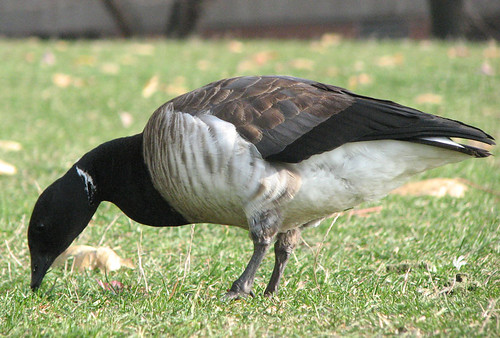
Photo courtesy of "Michael" on the Toronto and Southern Ontario Birding Forum.
On Saturday, a single Brant (pale-bellied) was reported from Harbour Square, Toronto, just west of Queens Quay where the ferries dock to cross to Center Island. The initial reporter mentioned that the bird was probably an escape as it was mingling with some resident Canada Geese in the small park next to the lake and was very easily approached. However, another person posted a reply on Sunday saying the bird actually had an injured leg (extreme swelling of the tarsus) and said that was the reason for the approachability. I decided to investigate (especially seeing as the bird is a lifer for me).
Here is where I attempt to rationalize why I am counting this species:
1) Time of year indicated that it could in fact be a wild-type bird as the report falls within fall migration dates.
2) The injury to the tarsus tells me that the bird stopped in a sheltered place in the small park among Canada geese in a metropolitan area where there is constant food availability and it is safer. Sadly, it could also mean it was injured by a pedestrian (I've seen Canada Geese along the Waterfront trail with injured wings). I believe it's due to the injury that the bird is so approachable (versus escapee). The leg is swollen enough that the bird will take a few steps then rest down on its belly and feed from a sitting position.
3) The bird didn't have any bands, nor did it have a deep belly, often demonstrated by domesticated waterfowl.
4) The bird was flying without any trouble, moving back and forth between the lake and the water (there is no beach here, so the geese have to fly over a railing to get to the lake).
5) I do not know Brant as a common domestic goose, nor do I often hear of escapes. However, when it comes down to it, someone could argue the exact opposite and probably convince me that the bird is uncountable. Perhaps a 6th point in my list could read "I need Brant for my lifelist." I guess I can rest easy on the fact that I'll no doubt get Brant in Ontario in the future.
Any thoughts?
Subscribe to:
Posts (Atom)